
IMU
Comparing motion signals that could help estimate orientation through a changing corner.
Exploring a compact device that could help motorcyclists understand lean angle, corner behaviour and ride data.
View developmentMany motorcycles do not provide lean-angle or detailed ride analysis. Riders interested in their cornering behaviour often lack a simple way to see what happened during a ride.
We are researching whether a compact independent device can capture relevant motion and route data without pretending that one number tells the whole story.
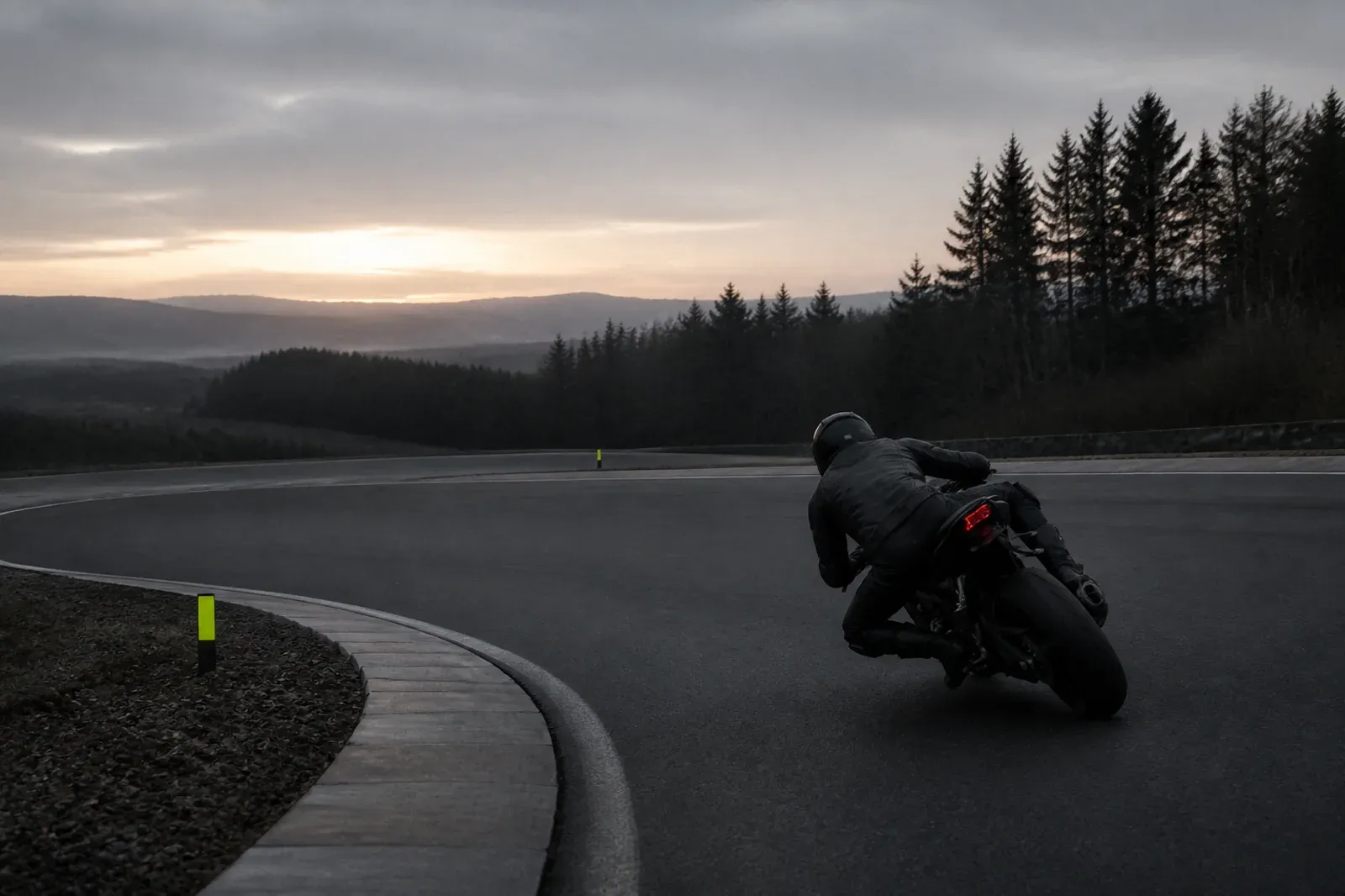
Useful rider insight starts with motion in context. The image represents the environment we are researching—not a finished device or a completed test.
Lean it yourself below and watch what each sensor would report.
A motorcycle in a steady corner does not lean against the cornering force — it leans until that force and gravity line up with its own vertical axis. At a 30° bank angle, gravity contributes 1.00 g downward and the cornering term contributes g·tan(30°) = 0.58 g toward the inside of the turn. They sum to 1.15 g pointing straight down through the machine, along the line from the rider to the contact patch. An accelerometer strapped to the bike measures that resultant and reports it as “down”, so it sees no tilt at all, no matter how far over the bike actually is. The lean angle is not buried in noise: at that moment it is genuinely absent from the signal. This is why lean angle has to be tracked as rotation over time rather than read from a single sensor, and why anything integrated over time then needs a second reference to stop it drifting.
This is standard motorcycle dynamics rather than a KAL STUDIO finding — the steady-turn force balance is covered in Vittore Cossalter, Motorcycle Dynamics (2nd edition, 2006, ISBN 978-1-4303-0861-4,catalogue record). What remains open, and what this project is actually researching, is how well it can be recovered on a real motorcycle once vibration, mounting position, road camber and changing speed are involved.
An accelerometer measures specific force, not tilt. In a steady corner the bike banks until gravity and cornering force resolve along its own vertical axis, so the sensor reads straight down through the bike and reports almost no lean. The information is genuinely absent, not merely noisy.
Idealised steady-state model — illustrative, not measured product data.The final architecture has not been selected. We are comparing how motion sensing, location, processing, power and software might work as one system. The challenge is not simply collecting signals, but understanding what they mean while vibration, mounting position, road camber and changing speed all influence the data. Every area below is therefore a research question, not a confirmed specification.
Comparing motion signals that could help estimate orientation through a changing corner.
Exploring how route, speed and position context could support interpretation after a ride.
Investigating what should be processed on the device before session data is transferred.
Considering practical setup and data transfer without making every ride depend on a phone connection.
Studying runtime, charging and mounting constraints for real use on different motorcycles.
Turning raw sessions into clear, responsible insight rather than unsupported numbers.
Research is focused on which signals can be captured reliably and which insights are genuinely useful to riders.
One answer, no account, nothing stored about you. This feeds the research directly.
Indicative only. This is an open web form, not a controlled sample, and it is reported as such.There is no finished product or release date. We are openly documenting the path from research to a validated direction.
Understanding the rider problem, measurement methods and product feasibility.
Which parts of a ride can be measured honestly with a compact device, and which cannot?
Defining the system, sensing approach, power and connectivity requirements.
What is the smallest system that answers the research question without over-building?
Waits on Research
Developing and validating the first electronic architecture.
Does the chosen architecture behave as expected outside a simulation?
Waits on Architecture
Building the first integrated hardware prototype.
Can the architecture survive being made physical at a usable size?
Waits on Electronics
Turning raw signals into reliable, structured device data.
How much interpretation belongs on the device rather than after the ride?
Waits on PCB prototype
Exploring installation, durability and physical product form.
Where can this mount on real motorcycles without changing what it measures?
Waits on PCB prototype
Comparing measurements with real riding conditions.
Do the numbers hold up against a known reference on a real road?
Waits on Firmware
Exploring how riders can review sessions, corners and progress.
What does a rider actually want to know after a ride, rather than during one?
Waits on Road testing
Production decisions follow only after the concept has been validated.
Has the concept earned the cost and commitment of being manufactured?
Waits on Road testing
Concept sketches, CAD studies and physical prototypes will be added as the design develops.
Because a motorcycle in a steady corner leans until gravity and cornering force line up with its own vertical axis. At a 30° bank angle, 1.00 g of gravity and 0.58 g of cornering force sum to 1.15 g pointing straight down through the machine, so an accelerometer measures that resultant, reports it as “down” and sees no tilt at all. Lean angle has to be tracked as rotation over time instead, which then needs a second reference to stop it drifting.
Not yet. Lean Angle is currently a research project and is not available for sale.
Installation and compatibility are part of the research. No supported-model list has been defined.
Accuracy targets will only be shared after the sensing approach has been tested and validated.
No. Every device visual on this site is an abstract concept study, not the final industrial design.
No. Lean Angle is research into reviewing ride data after a ride, not a safety system, a riding aid or a reason to ride closer to any limit. Nothing on this site should be read as encouragement to change how you ride.
No. The interactive model, the force diagram and the telemetry panel are illustrations of published physics and interface ideas. No measured data from a KAL STUDIO device has been published yet.
We are mapping the rider problem, measurement principles and the constraints of a compact device.
The first architecture update will follow when the research direction is sufficiently validated.
Occasional development notes from KAL STUDIO. Research, prototypes and the decisions behind the products.